
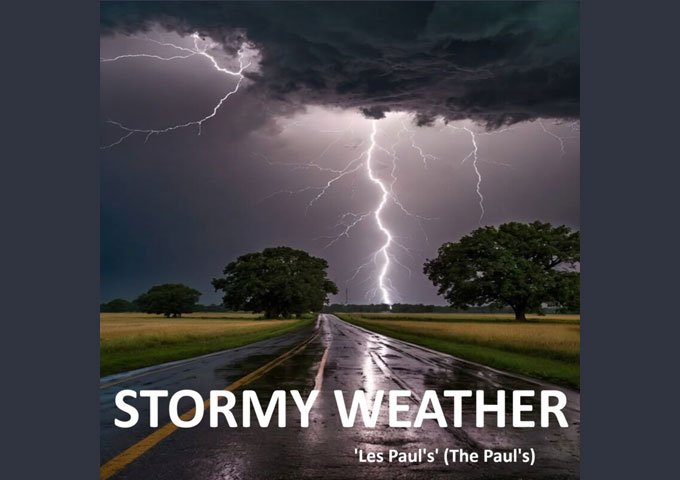
Albums like “Stormy Weather” by ‘Les Paul’s’ (The Paul’s) confront you head-on, refusing to let you look away. Marking their remarkable 30th release, this 10-track record does not arrive quietly. It crashes through the door with urgency, conviction, and an unrelenting sense that the world it reflects is teetering on a knife’s edge.
Released on 4 March 2026 through Swiss Cottage Recordz, London, “Stormy Weather” is a deeply contemporary work that dares to wrestle with the chaos of modern existence. At its core lies a powerful creative synergy: Paul Odiase, whose musical compositions and vocals pulse with raw, organic alternative-rock intensity, and Paul Robert Thomas, whose articulate pen carves narratives with insight, precision and emotional heft. Together, they craft a record that feels less like a collection of songs and more like a living, breathing document of unrest.
The album opens with its infectious title track, “Stormy Weather”, a harrowing meditation on collapse both intimate and global. What begins as the autopsy of a dying relationship quickly expands into something far more unsettling. The personal becomes political, the emotional becomes existential. There is a suffocating sense that nothing is stable anymore, that the same fractures tearing apart human connection are mirrored in the broader disintegration of society. The metaphor is as effective as it is chilling: when the pressure of lies builds, everything eventually buckles.
From there, the upbeat “I Can Tell” sharpens its focus into a biting critique of power structures and performative leadership. Driven by a slapping, insistent rhythm, the track strips away the veneer of authority to reveal something grotesque underneath. Hypocrisy, vanity, and greed parade like circus acts, with imagery that feels both surreal and disturbingly familiar. The sense of disillusionment is palpable, as if the song itself is shaking its head at a world that has confused spectacle with substance.
If those opening moments establish the tone, “The Rough and Rowdy Sea” expands the canvas dramatically. Here, the duo turns to metaphor with devastating effect, likening the resurgence of hatred and radicalization to an unstoppable ocean. The tide is rising, and it carries with it echoes of history that should never have been allowed to return. The track’s haunting atmosphere underscores its warning: the poison is not new, but it is spreading faster than ever in the digital age.
That sense of creeping infiltration continues in “The Wicked Wind”, a song that feels almost suffocating in its imagery. Where the previous track dealt with external forces, this one explores internal corruption. The “wind” is invisible yet pervasive, an airborne contagion of ideology and manipulation. The reference points are ancient, but the implications are frighteningly current. There is a call to resistance embedded within the track, but it is delivered with the weight of knowing how difficult that resistance has become.
Amid the album’s storm of socio-political commentary, “I Used To Do Those Things” arrives like a moment of uneasy stillness. It is not a retreat from the record’s themes, but rather a redirection inward. Here, ‘Les Paul’s’ (The Paul’s) examine the ego not as an abstract concept but as a lived reality. The confessional tone is disarming, cataloguing past mistakes and moral failings with a candor that feels almost uncomfortable. Yet it is precisely this vulnerability that gives the track its power. It reminds us that the same flaws we condemn in the world often exist within ourselves.
That spirited introspection spills into “It’s Another Wasted Year”, a song that captures the inertia of human existence with striking clarity. There is a sense of time slipping through fingers, of resolutions made and broken, of cycles that repeat with exhausting predictability. Musically, it leans into a gritty rock aesthetic, but lyrically it is steeped in quiet despair. The juxtaposition of hope and disillusionment creates a tension that lingers long after the song ends.
As the album moves toward its climax, “You Sold Me Out” delivers one of its most visceral punches. This is betrayal in its rawest form, framed through both personal and societal lenses. The echoes of biblical allegory intertwine with modern realities, painting a picture of a world where loyalty is traded for profit and integrity is an afterthought. The anger is justified, the delivery unflinching. It is a track that does not seek resolution so much as it demands accountability.
Then comes “The Silence For Iran”, perhaps the album’s most haunting moment. This song confronts the selective empathy of the modern world, where outrage can be manufactured and discarded with alarming ease. The imagery is stark, the message unmistakable. It forces the listener to reckon with uncomfortable truths about complicity and indifference, making it one of the album’s most affecting statements. . Here, ‘Les Paul’s’ (The Paul’s) pivot to the geopolitical heart of the record, delivering a devastating critique of selective activism and brutal suppression.
With “Guilty Clicks”, the focus shifts to the digital realm, and the result is nothing short of chilling. The song dissects the machinery of online judgment, where anonymity breeds cruelty and algorithms amplify outrage. The portrayal of a life dismantled by collective condemnation is both specific and universal. In an age where a single moment can define a person forever, the track serves as a stark warning about the cost of our clicks.
Finally, “Time To Change” closes the album with a sense of urgency that feels almost cinematic. It gathers the threads of everything that has come before and redirects them toward the listener. The storms, the winds, the waves, all of it leads here. This is not a passive conclusion but an active challenge. Responsibility is no longer placed on distant figures or abstract systems. It is handed directly to the individual, with the implication that change must begin at the most personal level.
What makes “Stormy Weather” so compelling is not just its thematic ambition, but its execution. Paul Odiase’s compositions are rich with texture, balancing grit and melody in a way that keeps the listener engaged even as the subject matter grows heavy. Meanwhile, Paul Robert Thomas delivers narratives that are as emotionally resonant as they are poetically impressive.
There is a sense throughout the album that this is a work born out of necessity rather than convenience. It does not chase trends or soften its edges for accessibility. Instead, it stands firm in its convictions, offering a mirror to a world that may not always like what it sees.
With “Stormy Weather”, ‘Les Paul’s’ (The Paul’s) have not only reached another milestone in their career but have also delivered one of their most important statements to date. It is an album that demands to be heard, not just for its musicality, but for its message. In a time when distraction is easy and depth is often avoided, this record insists on both. And perhaps that is its greatest achievement. It does not simply reflect the storm. It places you right in the middle of it, asking what you intend to do next.
OFFICIAL LINKS:
http://www.youtube.com/paulie56il
https://www.paullyrics.com/les-pauls-the-pauls-epk
https://lespaulsthepauls.bandcamp.com/music
https://www.facebook.com/paullyricist
https://www.instagram.com/paullyricist
https://www.facebook.com/LesPaulsThePauls
















+ There are no comments
Add yours