
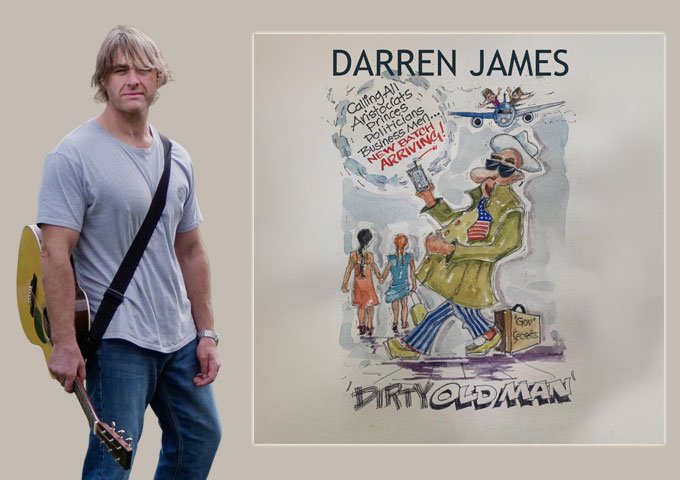
Darren James confronts predatory power head-on in his new single, “Dirty Old Man.” The Cardiff rocker builds a gritty, groove-driven portrait of a man who mistakes wealth for permission. Inspired by real conversations with survivors, the track refuses to soften its subject matter. Muscular guitars and a sneering vocal delivery give the story genuine teeth. It is a song built to be shouted back from the crowd.
Darren James has never been interested in writing around the truth. The Welsh singer-songwriter, who grew up in Quakers Yard in the Merthyr Valley before cutting his teeth in bands from the age of sixteen, has built a reputation across Cardiff and beyond as a performer who trades in real life rather than polished fantasy. Championed by Radio Cardiff and BBC Radio, and a fixture on festival stages both solo and with his band, he has spent years sharpening a specific skill: matching lyrics that don’t blink at difficult subjects to melodies catchy enough to lodge themselves in a listener’s skull for days. His new single, “Dirty Old Man,” is that skill at its sharpest.
Musically, the track is a throwback in the best sense, built on gritty guitar riffs, a resonant, rolling bassline and a drumbeat that slaps with genuine attitude. Produced by Ryan Griffiths, with Geraint Francis on drums and Calum Delaney on bass, the recording carries the tight, telepathic groove of a band that earned its chemistry the hard way, on stage, in front of crowds, long before anyone hit record. That live-honed instinct is audible in every bar. Nothing here feels programmed or overthought. It feels played, and played by people who trust one another completely. Darren James wrote the music and lyrics himself, sings lead and handles every guitar part, and his voice carries the song’s real weapon: a tenacious, sneering delivery that turns storytelling into indictment.
And the story he’s telling is not subtle, nor is it meant to be. “Dirty Old Man” builds the portrait of a man who has weaponized his own status, using wealth, charm and influence as tools of predation. The lyrics sketch a figure comfortable in his own impunity, someone who treats access to vulnerable people as a kind of entitlement, almost a perk of his position. James doesn’t rely on abstraction to make the point land. He gives the character a citadel, a shopping list, victims. The imagery is deliberately transactional, because the crime it describes is transactional. There is no romance in it, no ambiguity to hide behind. The song’s antagonist believes himself untouchable, and James lets that arrogance sit right at the center of the track, repeated back almost like a taunt, because the payoff of the song is watching that false confidence curdle.
Where the track escalates is in its second verse, where the scope widens from one man’s private cruelty to an entire network built to protect him. Presidents, princes, other wealthy men, all of them implicated in a system where a single phone call sets machinery in motion. People are dressed up, drugged, delivered. It is an ugly picture, and James paints it without softening a single brushstroke, because softening it would be its own kind of dishonesty. This is where the song stops being about one predator and starts indicting the structures, the fixers, the enablers, the whole apparatus that lets men like this operate in plain sight for years. It’s a bigger and more unsettling claim than most rock songs are willing to make, and James makes it without ever losing the track’s forward momentum or its hook.
That hook, the song’s chorus, is where the track’s fury crystallizes. The refrain brands the character outright: a monster in a suit, a deviant hiding behind respectability, a pervert operating according to a plan rather than a moment of weakness. That distinction matters. Darren James isn’t describing impulse or a single lapse in judgment. He’s describing calculation, premeditation, a pattern that repeats because no one has stopped it. The repetition of “dirty old man” throughout the chorus works almost like a public naming, stripping away the euphemisms that so often surround these stories in real life, where powerful men are protected by vague language and averted eyes. James refuses the vague language. He gives the monster a title and repeats it until it sticks.
What gives the song its real charge, though, is the story behind it. James has spoken about a night after a live performance when a woman who had been personally affected by the Jimmy Savile scandal approached him and thanked him for writing it. Her words, that somebody needed to say this stuff out loud, capture exactly what “Dirty Old Man” is doing. This isn’t a song reaching for shock value or courting controversy for its own sake. It’s a song built from the recognition that silence has historically protected predators far more effectively than any cover-up, and that naming the pattern out loud, bluntly and without hedging, can matter to people who lived through it. James has said audiences regularly come up after shows to talk about the track or sing the chorus back at him once the set ends. That kind of response, visceral and immediate, tells you the song is doing exactly what it set out to do.
It would be easy for a song this direct in its subject matter to feel heavy-handed or preachy, but “Dirty Old Man” avoids that trap by leaning entirely into rock and roll instinct rather than lecture. The groove is the delivery mechanism for the message, not a decoration on top of it. James and his band clearly understood that a song about abuse of power needed to sound powerful itself, needed teeth and swagger to match its subject, rather than retreating into something somber or ballad-shaped. The result is a track you can play loud, one that works on the strength of its riff and its chorus before a listener has even absorbed what it’s actually about, and then rewards closer attention with something far more serious underneath.
“Dirty Old Man” is Darren James doing what he does best: taking a real, painful, often unspoken experience and giving it a shape that people can shout back at him from a crowd. It’s uncomfortable in the way songs about uncomfortable truths should be, and it’s catchy in the way that ensures the truth actually travels. With its August 28th release through Sondar Records, the track continues James’s run of story-based songwriting that refuses to look away from the harder corners of human experience, proving once again that honesty and hook are not mutually exclusive, they’re most powerful when they arrive together.
OFFICIAL LINKS: https://www.sondar-records.com/darren-james











+ There are no comments
Add yours