






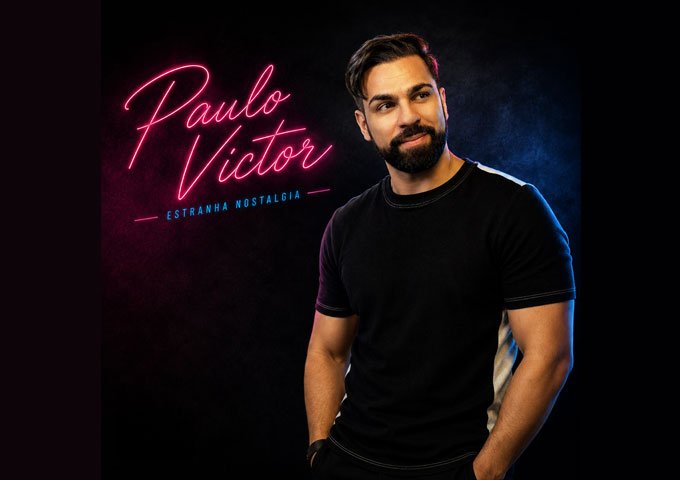
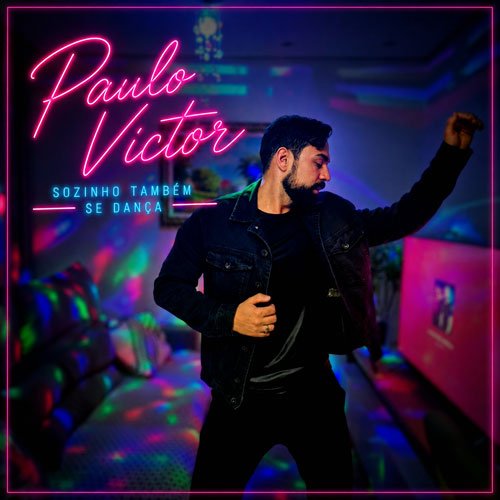
Paulo Victor’s current single, Sozinho Também Se Dança, was never meant to be about heartbreak alone. Instead, it became a statement about finding joy without waiting on anyone else. The songwriter discusses the real experiences that shaped the song and the video built around it. He also reflects on how the track fits into the broader story of his debut album, Estranha Nostalgia. This is his most personal single yet, explained in his own words.
Paulo Victor writes songs in the same language he teaches by day, turning the classroom’s attention to words into a career built quietly alongside it. The Brazilian songwriter and Portuguese language educator has spent his time outside the classroom shaping Estranha Nostalgia, a twelve track debut album that filters personal experience through the glow of 1980s inspired synthpop, all while writing every lyric in Portuguese for an audience he is now introducing far beyond Brazil.
The album’s first single, Catálogo de Vidro (Próximo), set the tone by picking apart the frustrations and contradictions of modern dating, a theme that runs quietly through much of what follows. Its current single, Sozinho Também Se Dança, takes a more personal turn. Born from a string of romantic attempts that never quite worked out, the song rejects the idea that being single means being unhappy, choosing instead to celebrate solitude as its own kind of company, complete with an official music video that moves between quiet reflection and nights spent dancing alone.
In this conversation, Paulo Victor discusses the life he balances between the classroom and the studio, the story and sound behind Estranha Nostalgia, and what he hopes listeners take from Sozinho Também Se Dança as they meet his music for the first time.
- You’re a Portuguese language teacher in public education by profession, and a songwriter by calling. When did you first realize those two identities were actually feeding each other rather than competing for your time?
Paulo Victor: I’ve always loved writing, and of course, writing is also a big part of my profession. As a Portuguese language teacher, I’ve always been very conscious of language — writing correctly, choosing words carefully, even avoiding abbreviations whenever I can.
But the connection with songwriting came from somewhere I didn’t expect. During therapy, my psychologist suggested that I start writing down my thoughts and feelings as a way to organize them. So I did, without ever imagining that those notes could eventually become songs.
Then, during another session, she told me, “You need to find a hobby, something you really enjoy.” And I thought, “Well, I love music. I’ve always wanted to record an album, and today there’s enough technology for me to explore that without needing a traditional studio. Why not try doing it myself?”
So I went back to some of those personal writings, started reorganizing them into lyrics, and suddenly the two worlds came together. The writing skills that had always been part of my life as a teacher became a way of expressing things that were much more personal. And that’s really how this whole project began.
- As a teacher, you spend your days helping students find the right words. Does that make you more patient or more restless when you’re searching for a lyric that isn’t coming easily?
Paulo Victor:They’re actually very different experiences. When I’m working with my students, my role is to guide them toward expressing themselves in the best way they can, but that process doesn’t happen on my timeline — it happens on theirs. They eventually get there, but learning takes time, and as a teacher I have to respect that.
With songwriting, all that pressure falls on me. I know what I want to express, so I can become much more anxious and restless trying to find exactly the right words, the right rhymes, and a way to connect all the ideas naturally. In that sense, writing a song can actually be much more difficult for me, because I’m both the writer and my own most demanding critic.
- What does a typical week look like when you’re balancing a full teaching schedule with writing, recording and promoting an independent album?
Paulo Victor: That part is a little crazy! Being a teacher in Brazil isn’t an easy routine, and I teach both in the morning and in the afternoon, so most of my songwriting happens on weekends. I usually write during more introspective moments, when I have some time to slow down and reflect — sometimes with a glass of wine, just spending some time with my own thoughts.
But ideas don’t necessarily respect my schedule. I actually created a WhatsApp group just for myself, and whenever a phrase, an idea or something interesting comes to mind, I immediately write it there. Then, when I finally have the time, I go back to those notes and start developing them into lyrics. It has become a kind of personal archive of ideas waiting to become songs.
- Independent artists often talk about creative freedom. For you, does keeping music outside your primary profession protect that freedom, or does it just make everything harder?
Paulo Victor: That’s a very interesting question! I actually think it gives me more freedom, because I don’t depend on music to make a living — at least, not yet! And honestly, I don’t know if that will ever happen. Music is something I do because I genuinely love it, while teaching is my profession, and I like to keep that distinction clear.
Because of that, I don’t feel pressured to make disposable music just to follow what is popular or commercially appealing. I want every song to have something meaningful behind it, something that can connect with people in some way — whether it’s a personal reflection, a tribute to someone, or simply a romantic song. I’m not particularly interested in creating something just because it might be catchy or fit into the mainstream. I know there is an audience for that, but at this point in my journey, it isn’t what I’m looking for. What matters most to me is being able to express what I genuinely feel. And I really value having the freedom to do that.
- As an independent artist, you handle so much of this project yourself. What has that process taught you about your own voice as a songwriter that you might not have discovered otherwise?
Paulo Victor: One of the most amazing things I’ve discovered through songwriting is how much I genuinely enjoy turning experiences and thoughts into lyrics. Looking at the songs I’ve written, I can see that there is often a kind of narrative built around memory. I like telling stories about things I’ve lived through, things I observe around me, and, of course, what I feel.
And there is one question that is almost always in the back of my mind when I’m writing: “Will this touch someone?” That matters a lot to me. I don’t want people to simply hear the words — I want them to feel the message behind them. I think discovering that has helped me understand what my voice as a songwriter really is.
- Your sound blends contemporary synthpop with 1980s influences. Was that identity something you set out to build deliberately, or did it emerge naturally as you started writing?
Paulo Victor: It was definitely deliberate. I absolutely love the sound of the 1980s. I’m a huge fan of artists like Cyndi Lauper, Laura Branigan, Donna Summer and Depeche Mode, and that whole sonic era has always appealed to me.
Something else that influenced me a lot is the work of the production trio Stock Aitken Waterman. I’ve always loved the way many of their productions could be romantic or emotional while still having this melodic, infectious beat underneath. The songs could carry feelings without necessarily becoming slow or overly sentimental, and that combination really appeals to me.
So when I started thinking about the musical identity of the album, I already knew: “This is the direction I want to go in.” I love synthesizers, I love that 1980s sonic aesthetic, and I wanted to bring those elements into a contemporary synthpop context rather than simply reproduce the past. That became the foundation of the sound of Estranha Nostalgia.
- Let’s turn to the music. For listeners discovering you for the first time, how would you introduce yourself and your sound?
Paulo Victor: I’d like people to see me as a contemporary artist who creates music inspired by the sounds and aesthetics of past decades. Nostalgia is an important part of my musical identity, but I don’t want my music to exist only as a recreation of another era.
Above all, I’d like to be recognized as a good lyricist — a songwriter who cares as much about the message as the sound. The production and the sonic aesthetic are very important to me, but there always has to be something behind them: an idea, a feeling, a story, something I genuinely want to communicate. That balance between sound and meaning is probably the best way I can describe myself as an artist.
- Your debut single, Catálogo de Vidro (Próximo), explores the frustrations and contradictions of dating apps. What observation about modern relationships made you want to write about that specifically?
Paulo Victor: The song came directly from my own frustrating experiences with dating apps. You can have thousands of matches and yet somehow none of them lead anywhere. And I’m not talking only about the way other people behaved toward me — I also started looking at the way I was behaving toward them.
These apps can make people feel like products in a catalogue. You keep browsing, looking for the best option, but even when you think you’ve found someone interesting, there is still this expectation that maybe the “next” person will be even better. I think that endless possibility has made human connections much more fragile.
And I don’t see this as something exclusive to one kind of relationship. It happens to straight people, gay people, everyone. I wrote the song from my own perspective, but after it was finished, many people told me they identified with it. That made me realize I wasn’t the only one scrolling all the way through this “catalogue” — the people on the other side were doing exactly the same thing.
I think Catálogo de Vidro (Próximo) is probably my most metaphorical song, but at the same time, one of my most immediate. The metaphor may be a catalogue, but the experience behind it is very real.
- How did Catálogo de Vidro (Próximo) set up the themes that run through the rest of Estranha Nostalgia?
Paulo Victor: I’m very proud of that song, and I think it was the best possible choice to open the album. It’s energetic and upbeat, but underneath that energy there is a very human frustration being explored, and that contrast became important throughout Estranha Nostalgia. The album often deals with relationships, emotions and personal experiences without necessarily presenting them through sad or introspective music.
Sonically, Catálogo de Vidro (Próximo) also taught me something. I blended synthpop with synthwave, and at first I actually worried that the song might fall somewhere between genres. That made it a little difficult to present to curators because I sometimes felt it wasn’t completely synthpop or completely synthwave. But listeners responded very well to it, and that gave me more confidence to experiment with the synthpop foundation of the album and bring other influences into it.
You can hear that freedom elsewhere on the album. Papo Banal, for example, blends synthpop with Latin pop, and I absolutely loved the result. Interestingly, it also has a theme that ties into Catálogo de Vidro, looking at contemporary relationships from another perspective. So there is both a thematic and a sonic connection between the two songs.
In that sense, Catálogo de Vidro helped establish something that became central to Estranha Nostalgia: the freedom to mix different sounds while using energetic pop music to talk about experiences and feelings that have much more going on beneath the surface.

- Now to your current single, Sozinho Também Se Dança. How would you introduce the song and its message to someone hearing it for the first time?
Paulo Victor: This is literally “my song.” It represents something I’ve learned over time and something I’ve discovered that many people can relate to. It’s about solitude, not loneliness; emotional freedom, not sadness.
I wanted the song to be reflective while still being something you can dance to. That contrast is very important to me because the message isn’t that being alone should feel sad or empty. It’s about realizing that your happiness doesn’t always have to depend on having someone beside you.
So Sozinho Também Se Dança invites you to dance, but at the same time, it asks you to reflect. You can enjoy the beat and the energy of the song, but underneath it there is a very simple message: sometimes, learning to enjoy your own company can also be a form of freedom.
- The title translates to “You Can Dance Alone Too.” What moment crystallized that phrase into a song?
Paulo Victor: The title actually came from two very personal experiences. The first was learning to go out by myself. I love flashback parties in São Paulo, and there were times when I didn’t have anyone to go with, so I simply started going alone. At first it was just a practical decision, but eventually I began to really enjoy it. I would arrive, get on the dance floor and dance by myself — and I realized I didn’t need someone beside me to have a good time.
The other inspiration is something that appears very literally in the lyrics. I love listening to music at home with a glass of wine, and sometimes I’ll find myself singing and dancing around the house on my own. I genuinely enjoy those moments.
Interestingly, someone recently said to me, “There’s a metaphor in that title, isn’t there? It means we don’t have to depend on someone else to be happy.” And I thought, “Yes, that actually makes perfect sense!” I hadn’t necessarily reduced the title to that single meaning when I wrote it, but I realized that all of these interpretations can coexist. Sozinho Também Se Dança can be about literally dancing alone, enjoying your own company, or, on a deeper level, understanding that your happiness doesn’t have to depend on another person.
- You’ve said the song isn’t about one specific breakup but about several romantic attempts that didn’t work out. How did you find one unified feeling across those different experiences?
Paulo Victor: In a way, Sozinho Também Se Dança is the result of the journey that begins with Catálogo de Vidro and continues through Papo Banal. In the first song, you confront the superficiality of modern relationships and the way people can sometimes use others simply to feed their own ego. In Papo Banal, you finally say, “Enough.” And then, in Sozinho Também Se Dança, you take what you’ve learned from those experiences and allow yourself to enjoy your own company and be happy without depending on someone else’s presence.
So I don’t see it as a song about romantic disappointment at all. It’s about learning how to live well and be happy with yourself before the right person comes along..
I went through periods when I felt that I needed to have someone beside me, that I needed a partner in order to feel complete. Over time, I learned that it doesn’t really work that way. First, you have to learn how to live with yourself, enjoy your own company and build a good relationship with who you are. Then, if love comes along, you already have the most important foundation in place: self-love.
- Sozinho Também Se Dança frames solitude as something joyful rather than sad. Was that a perspective you already held, or one you arrived at while writing it?
Paulo Victor: I actually lived through that process first, and the song came from it. I reached a point in my life where I learned to genuinely enjoy my own company and not depend on someone else in order to experience things. I go out by myself, I go dancing, I go to the movies, I go to the theater — I truly love spending time with myself.
That doesn’t mean I don’t want to share my life with someone. It simply means that I no longer need to wait for someone else in order to live it. There is a big difference between being alone and feeling lonely, and learning that difference was very important to me.
And because I was able to learn that, I’d love for other people to discover it too. That’s ultimately one of the messages behind Sozinho Também Se Dança: enjoying your own company is something you can learn, and yes, it really is possible.
- Walk us through the concept behind the official music video. What visual choices mattered most in showing solitude without making it look lonely?
Paulo Victor: I wanted the video to be as faithful to the lyrics as possible. I rented an apartment in São Paulo, brought my phone and a tripod — and that was basically it! I wanted to create a feeling of freedom and solitude through very ordinary moments: having a glass of wine at home, listening to music, dancing, reading a book or looking through photo albums.
I also made a point of showing details of the apartment itself, because there is something priceless about the comfort of being at home. Feeling completely at ease in your own space and enjoying being there by yourself is a wonderful kind of freedom, and I wanted the video to capture that warmth rather than make solitude look sad.
There is also a scene in the car, which was particularly challenging because I had to figure out how to film it by myself while the car was moving. It took some work, but eventually I got a take that worked!
The whole experience was very new to me. I’ve always been a little apprehensive about exposing myself publicly, so at one point I remember thinking, “If I’m going to make a music video, it has to be good and something I can be proud of, because my students are going to see it, my friends are going to see it, and my family is going to see it too!” In the end, everything worked out. It’s a simple video, but I think that simplicity is part of what makes it so faithful to the purpose of the song.
- The video moves between intimate reflection and nightlife scenes. How did you want those two moods to speak to each other?
Paulo Victor: What I wanted to show was very simple: there is a Paulo who is home alone and feels perfectly happy there, and there is also a Paulo who goes out alone and feels just as comfortable. I wanted those two sides to coexist because solitude doesn’t have to mean isolating yourself from the world.
And even after going out, when I come back home, I can still enjoy my own company — having a good glass of wine, dancing to my favorite songs, and simply enjoying that moment. Then the next morning, I wake up happy and make the most of being at home and all those simple, everyday pleasures.
So the nightlife and the intimate scenes are really two sides of the same idea: you can enjoy the world outside and you can enjoy the quiet of your own home. In both places, you can be alone without feeling lonely.
- Now let’s talk about Estranha Nostalgia as a whole. The title means “Strange Nostalgia.” What makes the nostalgia you’re exploring feel strange rather than simply sentimental?
Paulo Victor: I’ve always been a very nostalgic person. Contemporary music doesn’t usually affect me as deeply as older music does. Old comedy films make me laugh much more than most contemporary ones, and when it comes to horror movies, the trashier they are, the better! I often have this feeling that there was something about the culture and creative output of the 1970s and 1980s that connects with me much more strongly than what I find today.
And it goes beyond music and movies. When I visit a museum, for example, I sometimes catch myself imagining what it would have been like to live in another era — who I would have been, how I would have lived, and how I would have fit into that world.
That’s where the “strange” part of Estranha Nostalgia comes from. There’s actually a word that describes this feeling quite well: “anemoia” — nostalgia for a time you never experienced. I feel nostalgic for things and eras that I never actually lived through. I often feel a little out of step with people my own age: I talk about artists, films and cultural references that sometimes they don’t even know.
The title track is very faithful to that feeling. Sometimes I joke that my soul lives somewhere in the past, while my body is stuck here trying to figure out how to fit into the present. (laughs) And I think that contradiction is exactly what Estranha Nostalgia means to me.
- With twelve tracks moving through nostalgia, relationships, self-discovery and resilience, how did you decide on the emotional arc and sequencing of the album?
Paulo Victor: I definitely thought of the sequencing as a narrative. The album begins with songs dealing more with disappointment, relationships and criticism, and then gradually moves toward more motivational and inspirational themes. There is also a romantic moment before the album enters its final section, which is much more about paying tribute and expressing gratitude.
That final sequence is especially meaningful to me. It begins with a song dedicated to teachers, then moves into a very personal tribute to my dear and beloved mother, Lourdes, and finally closes with a song expressing my gratitude to God.
So the order wasn’t random at all. I wanted the listener to move through different emotional stages — from frustration and questioning toward resilience, affection and, ultimately, gratitude. Did it work exactly the way I planned? I don’t know! (laughs) But that was certainly the journey I had in mind when I put the album together.
- What first drew you to 1980s synthpop specifically as the sonic identity for this project, rather than another retro sound?
Paulo Victor: As I mentioned earlier, I’ve always been deeply attracted to that sound. I remember listening to songs like Laura Branigan’s Shattered Glass, Donna Summer’s This Time I Know It’s for Real, and Rick Astley’s Never Gonna Give You Up and thinking, “This is what pop music should still sound like today! If I ever make an album, I want it to sound like this.” So in a way, that sonic identity existed in my imagination long before the album itself did.
What fascinates me about that kind of synthpop is its ability to be melodic, emotional and danceable at the same time. The synthesizers and rhythms can give a song tremendous energy without taking away from the emotion of the lyrics. That combination felt perfect for the kind of songwriter I wanted to be.
At the same time, I didn’t want Estranha Nostalgia to be twelve variations of exactly the same sound. Synthpop became the foundation, but I allowed it to interact with other styles throughout the album — there are elements of rock, Latin pop, and even R&B on Consciência. Pilar da Nação (Professor) is actually the one song that steps away from synthpop entirely. I conceived it closer to MPB and Brazilian pop rock because it is a tribute to teachers, and I wanted it to have a sound that could feel natural and accessible when played in schools.
- You write all your lyrics in Portuguese. What would be lost about Estranha Nostalgia if it existed in English instead?
Paulo Victor: I do think the album might have had a broader international reach if it were in English. During the promotion process, I noticed that some European curators — with Spain being a notable exception — seemed less receptive to songs in Portuguese, while I found a warmer response in countries where Romance languages are spoken. I may be wrong, of course, but after seeing that pattern in the submissions and rejections I received, it was difficult not to wonder whether language played a part.
But Portuguese is my native language, and I’m extremely proud of it. There is a famous verse by the Brazilian poet Olavo Bilac describing Portuguese as “a última flor do Lácio, inculta e bela” — “the last flower of Latium, uncultivated and beautiful.” That relationship with the language is part of who I am.
If these songs weren’t in Portuguese, I think they would lose part of their identity, their sense of belonging, their originality and, above all, their truth. They would lose something deeply personal. Portuguese is not only my native language; it is also the language I work with every day as a teacher. To leave it behind in my songwriting would make very little sense to me.
And I also like to look at it from another perspective: I’m making synthpop — a genre with very strong European roots — in Brazilian Portuguese. There is something exciting about bringing those two worlds together, and, as far as I know, it is still a path relatively few Brazilian artists have explored.
Could I record something in English someday? Maybe. I would never rule it out. But for now, it isn’t in my plans. Portuguese is where these songs belong.
- For someone hearing Estranha Nostalgia for the very first time today, starting with Sozinho Também Se Dança, what do you most want them to understand about the album as a whole?
Paulo Victor: More than anything, I hope these songs can touch people’s hearts — or at least touch their consciousness and make them think. I don’t want people to see me as someone who is simply chasing fame. I’d rather be seen as someone who makes good music, has something meaningful to say, and can still make you move your body while saying it.
If someone listens to Estranha Nostalgia from beginning to end, I hope they come away feeling that the album made them think, reflect, dance, love themselves, enjoy life, respect others and appreciate the people and things that truly matter.
And for listeners who don’t speak Portuguese, I would actually encourage them to translate the lyrics into their own language. The production and melodies are an important part of Estranha Nostalgia, of course, but there is another entire layer of the album inside the words. If you understand the lyrics, you understand much more of the concept and much more of who I am.
So if someone discovers me today through Sozinho Também Se Dança and then decides to explore the whole album, that’s what I would want them to find: music they can dance to, but also music that leaves them with something to think about after the song is over.
OFFICIAL LINKS:
Linktree: https://linktr.ee/paulovictorsqr
Spotify – Artist Profile: https://open.spotify.com/intl-pt/artist/04OCy4vGRe42Xp6EQljIek
YouTube – Official Artist Channel: https://www.youtube.com/@PauloVictor.Oficial
TikTok: https://www.tiktok.com/@paulovictorsqr
Instagram: https://www.instagram.com/paulovictorsqr/
Instagram 2: https://www.instagram.com/paulo.victoroficial